
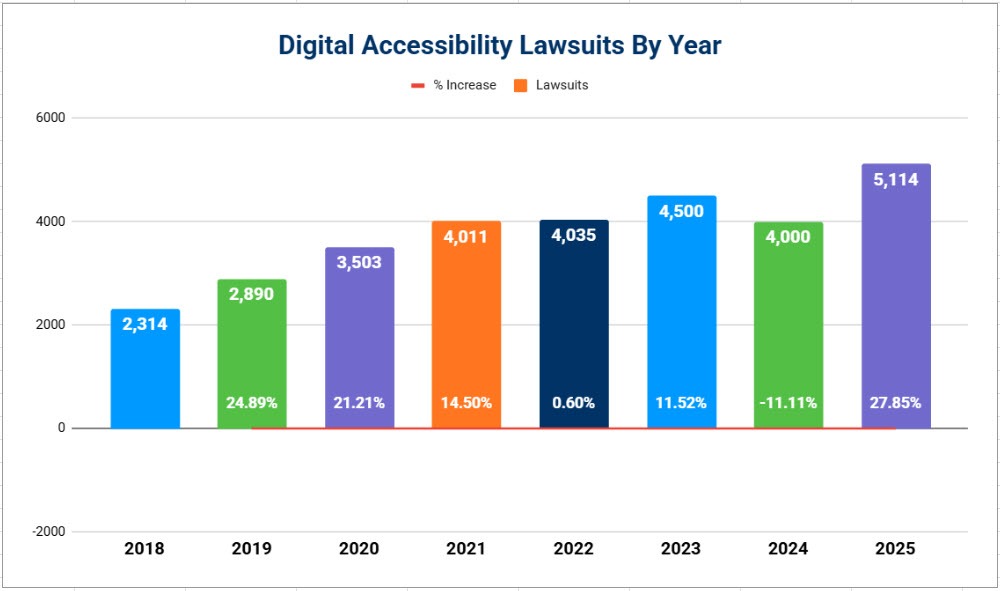
In 2025, 8,667 ADA Title III lawsuits were filed in federal district courts — only a slight 2% decrease from 2024 and still nearly three times higher than a decade ago.
Of these, 5,114 are tied to digital accessibility claims, including websites, mobile apps, and online services.
These cases typically allege barriers such as:
- Inaccessible navigation
- Missing alternative text
- Improper form labeling
- Checkout barriers
- Inaccessible PDFs or downloadable documents
Most notably this year, digital accessibility lawsuits and settlements are no longer confined to federal court.
Plaintiffs Are Expanding Where and How They File
In 2025, plaintiffs increasingly filed in state courts, particularly in New York and California. These courts allow plaintiffs to recover financial damages, not just injunctive relief, court costs, and legal fees. Some states also have lower standards by which the plaintiff must prove injury, and may interpret a website as a “place of public accommodation” more broadly.
State court filings can sometimes present strategic advantages for plaintiffs, including procedural differences and reduced early dismissal opportunities. This shift means federal Title III numbers alone do not capture the full scope of digital accessibility litigation risk.
Federal filings remain concentrated in:
- California – 3,252 cases
- Florida – 1,823 cases
- New York – 1,471 cases
However, because digital businesses operate nationally, organizations outside these states are still exposed if users in those jurisdictions access their websites or services.
Don’t write off demand letters
Organizations that look only at federal totals may underestimate exposure. The broader trend shows that digital accessibility remains an active and evolving area of ADA enforcement driven largely by private plaintiffs rather than government agencies.
It’s been estimated that between 7-10 private demand letters are filed for every 1 claim filed in court.
While a strongly worded letter sounds less threatening than a lawsuit, these letters commonly warn that legal action will be pursued unless the recipient makes its digital resources accessible. Demand letters are also undesirable because they often result in financial settlements, which are undisclosed and not dependent on precedents set by past cases.
Accessibility Widgets Are Not a Legal Shield
A continued theme in 2025 filings: websites using accessibility overlays or widgets are still being sued.
Plaintiffs argue that overlays:
- Do not remediate underlying code issues
- Often conflicts with assistive technology functionality
- Fail to meet WCAG success criteria
Compliance requires fixing the source code and content — not layering on a tool.
PDF Accessibility: A Growing Litigation Risk
While most digital accessibility lawsuits focus on websites and mobile apps, PDFs and other downloadable documents present a significant source of legal exposure. Inaccessible PDFs can create the same barriers as inaccessible web pages, particularly when they contain missing document tags, improper heading structures, incorrect reading order, untagged tables, images without alternative text, or inaccessible form fields. In sectors such as higher education, healthcare, government, and finance, these barriers can directly impact a person’s ability to access essential services or information. Necessary documents including forms, policies, reports, instructional materials, and more must be accessible to assistive technology users. Proactively auditing and remediating public-facing PDFs is an important step in reducing overall digital accessibility risk.
Why Lawsuit Risk Remains Elevated
Several factors continue to drive digital accessibility litigation in 2025. The ADA still lacks a clearly codified federal technical standard specifically written into the regulations for websites, leaving room for interpretation and dispute. At the same time, enforcement remains largely in the hands of private plaintiffs and repeat-filing law firms rather than federal agencies. Awareness of digital accessibility rights has grown significantly, and automated scanning tools make it easier than ever to identify potential barriers at scale. Coupled with the continued expansion of digital-first business models, where core services, transactions, and communications happen online, these factors ensure that accessibility is no longer a niche concern but a mainstream compliance and risk management issue.
What Organizations Should Do in 2026
To reduce legal exposure and improve user experience:
1. Conduct a Comprehensive Accessibility Audit
- Website templates
- Mobile experiences
- PDFs and downloadable documents
- Forms and transactional flows
2. Prioritize Code-Level Remediation
Fix structural issues instead of relying on overlays.
3. Implement Ongoing Monitoring
Accessibility is continuous — not a one-time project.
4. Establish Governance & Documentation for Maintenance
- Accessibility policies
- Remediation logs
- Testing records
- Vendor accessibility requirements
5. Address PDF Accessibility Strategically with Remediation Workflows
- Legacy documents
- Recurring reports
- User-submitted forms
- High-value compliance materials
Final Thoughts: Accessibility Is Risk Management
Although federal ADA Title III filings declined slightly in 2025, digital accessibility litigation remains firmly entrenched at elevated levels. Organizations that treat accessibility as core infrastructure rather than a reactive crisis response are better positioned to reduce legal exposure, improve customer experience, expand market reach, and meet evolving regulatory expectations. The data is clear: digital accessibility lawsuits are not going away, and proactive remediation — including both website and PDF accessibility — remains the most reliable path forward.
Nina Overdorff
Nina comes to Equidox with years of sales and marketing experience from a variety of industries and holds a BS in Language Arts Education. Nina has a passion for words, storytelling, and information, which she believes everyone should have access to regardless of ability. After spending time as a teacher with a blind student, she became much more aware of the limitations and abilities of web accessibility, and how essential it is to those experiencing disabilities. “Being able to access information equally ensures that everyone has an equal opportunity for education, employment, and success in life.”

Let’s talk!
Speak with an expert to learn how Equidox solutions make PDF accessibility easy.